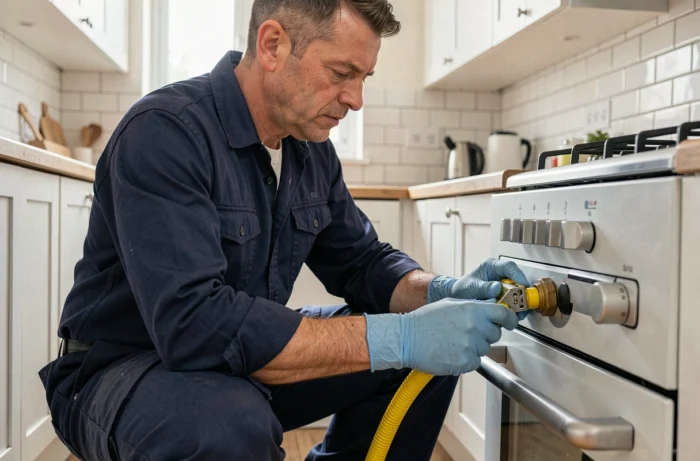
You connect a cooker, push it against the wall, and the hose disappears behind the unit. A few months later, you notice a suspicious smell: the hose was pinched against the edge of the countertop.
This scenario remains one of the most common causes of household gas leaks at a connection. Choosing the right gas hose length is about more than measuring the distance between the cylinder and the appliance: you also need to account for movement, space constraints and mechanical wear on the hose.
Check the hose after fitting or moving an appliance
Regulations require the hose to remain visible along its entire length. In practice, after pushing a cooker into place or repositioning an oven, the hose often disappears from view. Make a habit of gently pulling the appliance towards you before turning the gas back on, so you can inspect the hose along its entire length.
Check three specific points. The hose must not form any tight loops or sharp bends. No connection should be under tension, even slightly, when the appliance is in its final position. The hose must not touch the back of the oven or any surface that could heat up.
Even a new hose can become dangerous if it is crushed between the wall and the appliance. Its expiry date does not protect it from mechanical damage caused by poor positioning. If the hose is trapped, do not try to free it by force: turn off the gas at the shut-off valve, then carefully reposition the appliance.
The calculation of a gas pipe’s diameter also depends on the connection setup: a hose that is too short puts strain on the fittings, while one that is too long can form loops that get trapped behind the unit.
Maximum gas hose length: what the regulations say
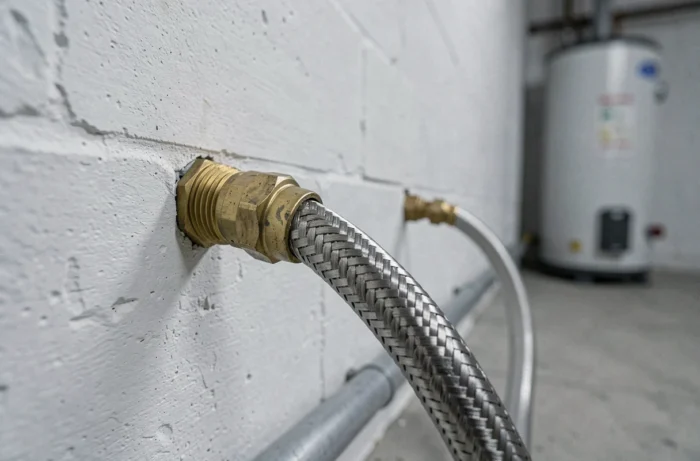
For a household appliance, the general rule set out in the order stipulates a maximum length of 2 metres for a flexible hose or soft tube. This limit covers the vast majority of cookers, hobs and ovens connected to natural gas, butane or propane.
Two metres may sound generous. In reality, it is a maximum, not a target. The right length is the shortest one that lets you move the appliance for cleaning or maintenance without putting strain on the connections. A 1.5 m hose is sufficient for most standard kitchens, where the shut-off valve is right next to the appliance.
When the 2-metre limit does not apply
The order sets out specific provisions for certain equipment, particularly in boiler rooms. The 2 m limit is therefore not a universal rule for all gas pipes. If you are unsure about a specific installation (for example, a wall-mounted boiler located far from the meter), a certified PG professional is the only reliable point of contact.
Choosing between a rubber and stainless steel hose for your gas installation
The material you choose determines the hose’s service life and how often it needs replacing. Two main types dominate the domestic market.
- Rubber (or elastomer) hoses have an expiry date printed on the outer sheath. They are suitable for bottled butane and propane, cost little, but must be replaced by the expiry date, even if they still look intact.
- Stainless steel hoses with an unlimited service life have no expiry date. They connect by screwing on, with an integrated seal, and are suitable for natural gas, butane and propane. Their higher price is offset by the fact that they do not need periodic replacement.
- Soft tubes with mechanical fittings (ROAI type) provide a solder-free connection. They are suitable for installations where you want to be able to disconnect and reconnect the appliance easily.
“No expiry date” does not mean “no inspection”. Replace a stainless steel hose as soon as it shows signs of cracking, hardening, crushing or visible corrosion, regardless of its age.
Gas connection safety: the safety shut-off device and emergency steps
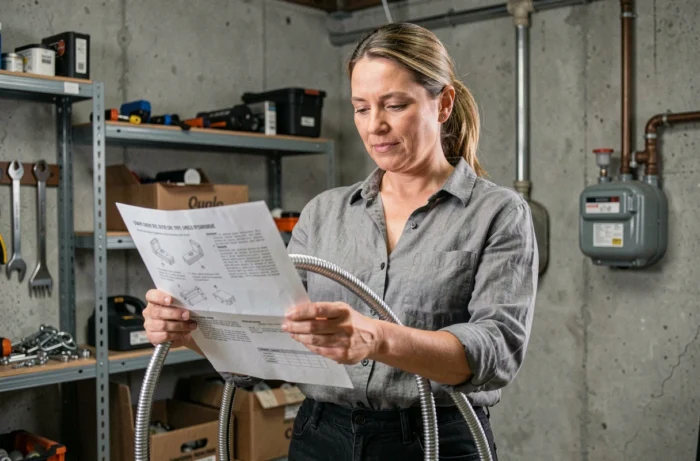
Beyond choosing the hose, safety depends on the connection itself. Regulations require a safety shut-off device to protect against accidental disconnection or hose failure. This mechanism automatically cuts off the gas if the flow becomes abnormal.
Check your installation documentation (or ask a professional) to make sure this device is present and working properly. It may be missing or out of service in an older installation.
What to do if you smell gas
Do not try to find the leak or touch any electrical switches. Turn off the gas valve only if you can do so safely. Open the windows to ventilate the area, leave the property and call the gas emergency service from outside.
One point that is often overlooked: if the smell disappears after airing out the room, that does not prove the leak has been fixed. The gas concentration may simply have fallen below the threshold detectable by smell. Have a technician inspect the installation before using it again.
Pre-use inspection checklist
- The hose is visible along its entire length, with no section running behind a closed unit or beneath a covering.
- It is long enough to move the appliance without straining the connections, and does not exceed 2 m for a standard household installation.
- The hose does not touch any hot surface (oven wall, flue).
- The expiry date (rubber hose) has not passed, or the hose’s visible condition (stainless steel hose) shows no cracks or deformation.
- The safety shut-off device is present and working at the connection point.
A correctly sized and installed gas hose only needs a few minutes of inspection each year. The right length is long enough to let you pull the appliance out, but not so long that it forms a loop or becomes taut—and the hose should always be easy to see and reach.