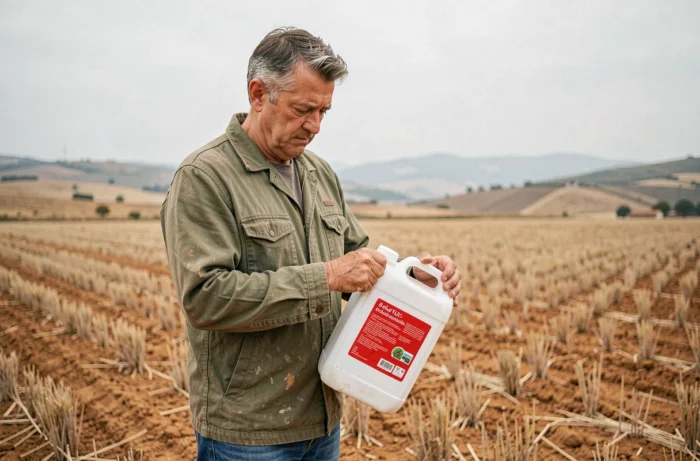
Buying glyphosate 360 in Portugal may seem straightforward: the product is available over the counter at some agricultural retailers, and there are no routine customs checks at the border with Spain or France. The catch lies elsewhere. EU approval of the active substance does not automatically mean that a commercial product is authorised for sale in Portugal, let alone in the country where you intend to use it.
Product authorisation in Portugal: check the SIFITO register before buying
Glyphosate, as an active substance, has had its approval renewed at EU level. This renewal prohibits its use as a pre-harvest desiccant and sets application limits, as well as measures to protect non-target plants and small herbivores.
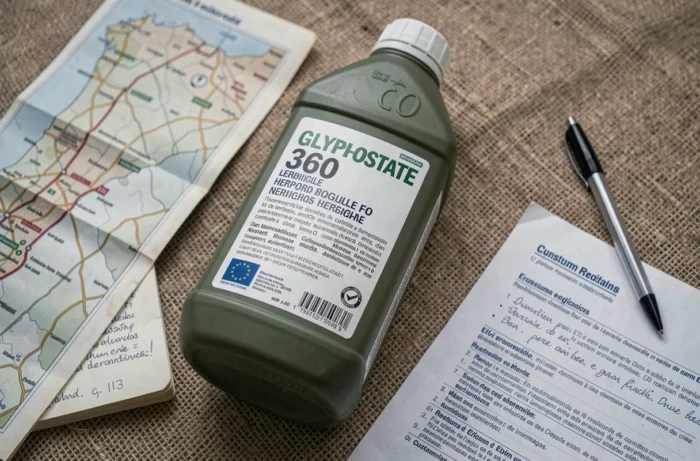
EU approval alone is not enough. What matters is the national authorisation of the commercial product, not that of the molecule. In Portugal, the SIFITO register, managed by the DGAV (Directorate-General for Food and Veterinary Affairs), lists each plant protection product along with its authorisation number, status (authorised, cancelled, suspended) and conditions of use.
Two products containing glyphosate 360 g/L may have completely different statuses in this register. One may be authorised for perennial crops, while another may have been cancelled several months ago. A cross-border buying guide for Portugal explains what to check in the register before making the trip.
- Search for the product’s exact trade name in SIFITO, not just “glyphosate 360”.
- Note the authorisation number on the label and compare it with the number in the online register.
- Check the status: a product marked “anulado” (cancelled) can no longer be sold, even if there is still stock on the shelf.
- Check the authorised uses: some products are restricted to specific crops or for professional use only.
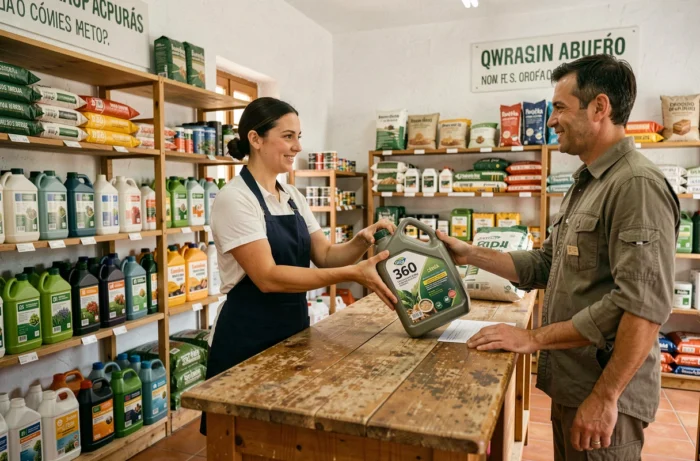
Sell-by date and use-by date: two separate deadlines for glyphosate
Have you ever noticed two different dates on a container of plant protection product? Many cross-border buyers overlook this detail, which can turn a legal purchase into an offence.
When a marketing authorisation is cancelled in Portugal, the product does not disappear from store shelves immediately. The sales and use periods may extend beyond the cancellation date. In practice, a distributor may continue selling its stock for a set period after the cancellation date. Users then have a second period in which to use products they have already purchased.
The problem arises when you buy a container that is still legally on sale in Portugal, but whose use-by deadline falls before your next weed-control season. You are left with a product you are no longer allowed to use, even in the country where you bought it legally.
How to check these two dates
The product label gives the manufacturing date or chemical expiry date, but the regulatory end-of-sale and end-of-use dates are listed in the SIFITO register. They are not always printed on the container. Before paying, compare the label information with the details in the online register.
If the product is in a stock-clearance period (still authorised for sale but no longer being renewed), check whether your application window falls before the use-by deadline. Buying in autumn for use the following spring could put you past the deadline.
French regulations and cross-border transport of glyphosate
A purchase that is perfectly legal in Portugal does not guarantee anything once you cross the border. In France, the use of plant protection products by private individuals is strictly regulated. A French resident bringing glyphosate 360 back from Portugal must make sure that the product and its intended use are authorised in France.
The rules are different for agricultural professionals, but restrictions still apply. The product being transported must have a valid marketing authorisation in France (not Portugal). Authorisations are national, so a commercial product authorised in Lisbon may not be authorised in Paris, even if its composition is identical.
Practical risks when transporting the product
Transporting plant protection products between EU member states is not subject to routine customs checks. However, checks may take place during roadside inspections or targeted enforcement operations.
- A private individual transporting glyphosate risks having the product seized and receiving a fine if it is not authorised in France.
- Professionals must prove that the product is authorised in the destination country and that they hold the certificates required under national regulations.
- Transporting large quantities without documentation may be treated as illegal placing on the market.
Product cancelled between purchase and use: what options are available?
What should you do if you buy glyphosate 360 in Portugal legally, but its authorisation is cancelled before you use it? This is not a hypothetical scenario. Plant protection products are frequently reassessed, and their status can change between the time you buy them and your application season.
The first step is to check whether the cancellation decision provides for a transitional period of use. In most cases, a grace period applies. If you are still within that period, the product can be used under the original authorisation conditions.
Once the grace period has expired, the product becomes plant protection product waste. It must not be used, resold or disposed of with household rubbish. Plant protection product waste collection schemes in both France and Portugal accept these products for disposal.
EU regulations do not provide for a refund in this situation. The retailer is not required to take back a product that was legally sold but whose authorisation was withdrawn after the sale. Some retailers may offer a goodwill gesture, but they are under no obligation to do so.
The only way to reduce this risk is to buy quantities suited to a single application season and check that the authorisation status is secure before making the trip. A product whose renewal is under review carries a higher risk than one that has recently been reauthorised.