
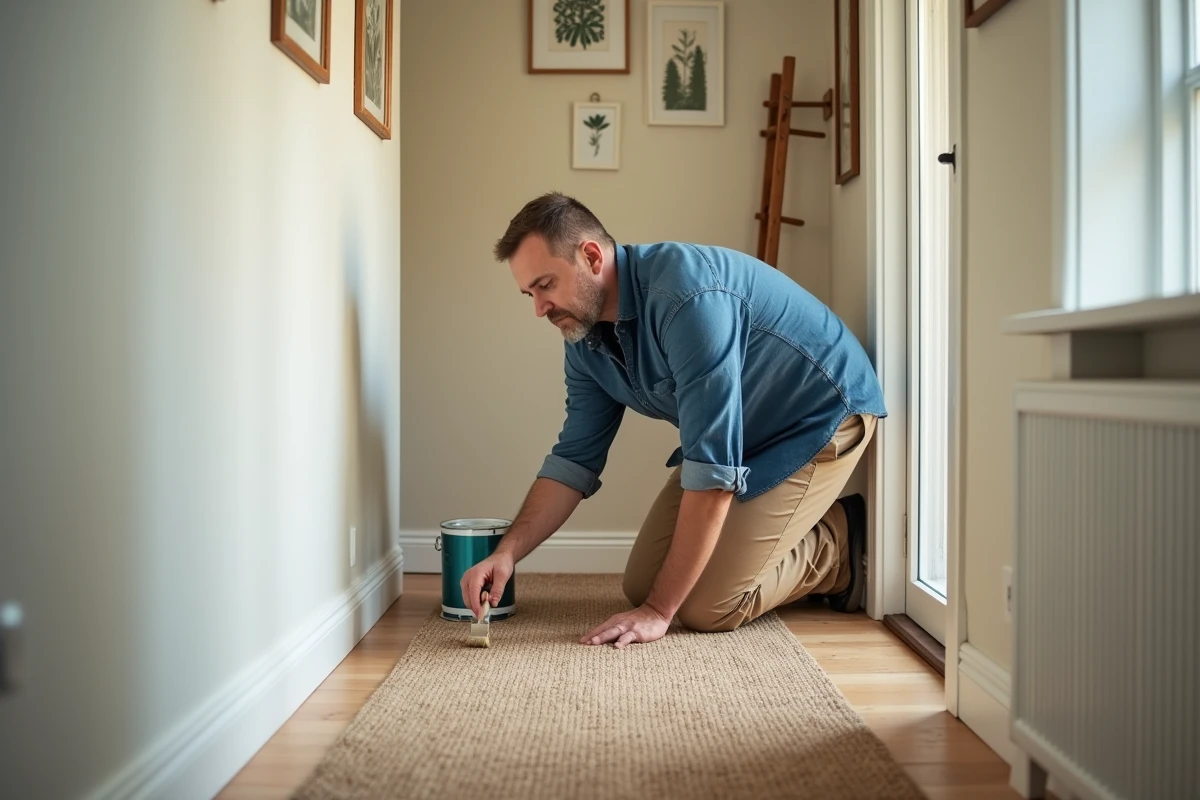
Most classic paints do not adhere well to sea rush due to its fibrous surface and plant composition. Some manufacturers claim to offer universal solutions, but these products often fail to guarantee adhesion and durability. Applying an inadequate coating can lead to peeling, stains, or premature alteration of the fibers.
Eco-friendly alternatives like sea rush and sisal present specific constraints, often overlooked when choosing a finish. Differences in texture, moisture resistance, and compatibility with paints create precise technical requirements.
Sea Rush and Sisal: Understanding the Differences and Ecological Benefits
In the family of natural flooring, sea rush holds a unique place. Derived from an aquatic plant primarily grown in China, it withstands moisture better than most plant fibers. This makes it a strong ally for the bathroom or kitchen, where other materials quickly give up. Its dense and even weave provides appreciable thermal and acoustic insulation. However, it is not an invincible material: it deforms under too much sunlight, fears dryness, and can become slippery on stairs. Its behavior requires continuous vigilance.
Sisal, on the other hand, comes from the agave plant. It is recognized for having a lower environmental impact due to its low-input cultivation and respectful processing. Less tolerant to water, it prefers dry rooms. A notable advantage is that it can be dyed directly in the mass, offering a much wider color palette than sea rush. To color the latter and achieve a uniform result, it is better to choose a paint suitable for sea rush: generic solutions rarely keep their promises and risk damaging the fiber.
Another player enters the discussion: coconut. Made from coconut husk, this covering demonstrates remarkable strength against abrasion and dirt. It withstands wear but not moisture, which confines it to the driest spaces. These three fibers share the same plant origin, but their use and behavior differ significantly from one room to another.
From a financial perspective, sea rush prices range from €7 to €40 per square meter, depending on quality and origin. Sisal and coconut fall within a similar range, but each material imposes its own concessions on durability or water resistance.
To make a good choice, carefully examine the room’s use, humidity level, and foot traffic. Opting for a paint suitable for sea rush remains the best way to preserve the floor’s appearance without compromising the coating’s strength or the coherence of your decor project.
What Finishes and Colors to Choose to Enhance a Natural Fiber Floor?
The choice of finish on a sea rush or sisal floor changes everything, both for the atmosphere and for longevity. Choose a matte or velvet paint if you appreciate discreet elegance and ease of maintenance: they better camouflage marks and harmonize with the softness of the fibers. Satin finishes, which are more luminous, are suitable for high-traffic areas, but any roughness in the fibers becomes visible. To ensure adhesion, apply a well-chosen primer, either acrylic or universal, that evens out the irregular surface of these materials.
The color should interact with the light and texture of the floor. Light shades, such as white, beige, pearl gray, and linen, visually enlarge the space and spread light, making them ideal for north-facing rooms. Warm colors like terracotta, brown, or orange immediately warm the atmosphere, perfect for creating a cozy environment in living areas. Wooden furniture, mineral walls, or natural accessories fit perfectly on these floors.
Here are some combinations that work particularly well:
- White or beige: to open up the space and create a peaceful atmosphere.
- Gray, taupe: the ally of a sober, contemporary, and timeless interior.
- Blue or green: to highlight a bright room facing south.
- Yellow, orange: the solution to energize a dark space or a narrow hallway.
Also consider biosourced paint, low in VOCs, which improves indoor air quality. Some ranges go further by even transforming formaldehyde, a common pollutant in modern homes. For each room, adjust the color to the orientation and use: the natural floor will then find its rightful place without ever losing its uniqueness.
Maintenance, Durability, and Environmental Impact: Everything You Need to Know Before Getting Started
Sea rush is appealing for its raw nature but requires adopting good habits for longevity. Regular maintenance makes all the difference: vacuum frequently to prevent dust from settling. To refresh the floor, a damp mop is sufficient, provided you never saturate it with water, or else the covering may deform. Small stains often come off with white vinegar, baking soda, or a bit of lemon juice. There’s no need to scrub too hard: patience and gentleness do more for the floor’s longevity.
In terms of resistance, sea rush shows some limitations. It does not handle impacts and prolonged sunlight well: when exposed all day, it eventually warps. On stairs, it can become slippery. In very high-traffic areas, it wears out quickly. However, in a humid room, it showcases all its qualities: water resistance, thermal insulation, and acoustic insulation. For a durable installation, it’s best to entrust the laying to a professional craftsman. Expect to pay between €40 and €50 per square meter for a result without unpleasant surprises.
The choice of biosourced paint is also justified by health: it limits the release of VOCs into the air and acts on formaldehyde, a pollutant still too present in homes. Favor labeled products: the air is healthier, and the ecological footprint is lighter. Between cost, easy maintenance, and respect for the environment, sea rush ticks many boxes, provided each step is respected, from material choice to carefully applied finish.
Ultimately, a well-chosen and well-painted natural fiber floor transforms the space. The question remains: what shade will you dare to make your room vibrate?