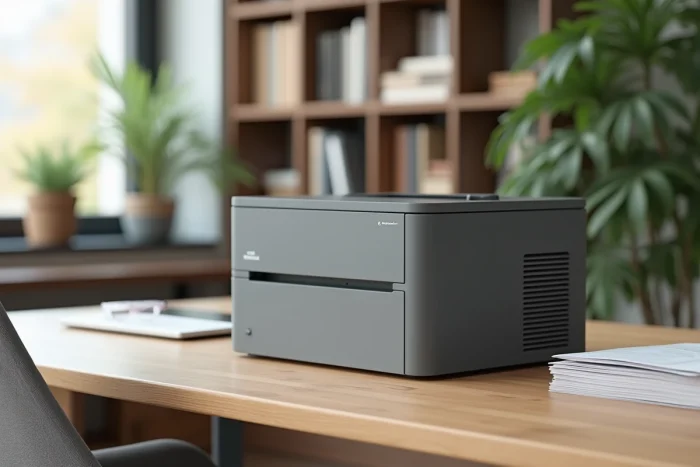
When replacing a desktop printer or equipping a new workstation, the question is rarely posed in this way: laser or LED. We often compare laser and inkjet, but LED technology remains unknown even though it shares the same basic principle as laser. Understanding what separates these two exposure mechanisms allows for a choice that suits one’s printing volume and space constraints.
Exposure mechanism: what changes in the engine
A laser printer uses a single light beam, directed by a rotating mirror (the polygon), to draw the image line by line on the photosensitive drum. The toner is then attracted to the exposed areas and fused onto the paper by heat.
An LED printer replaces this mirror and single beam with a line of diodes aligned across the entire width of the drum. Each diode corresponds to a point on the line. Exposure occurs in a single pass, without any intermediate moving parts.
This difference may seem minor on paper. In practice, it has direct consequences on the footprint, noise, maintenance, and mechanical reliability of the print block. When trying to understand the difference between laser and LED printers, it is this technical starting point that sheds light on all other criteria.
Footprint and noise: the practical advantage of LED
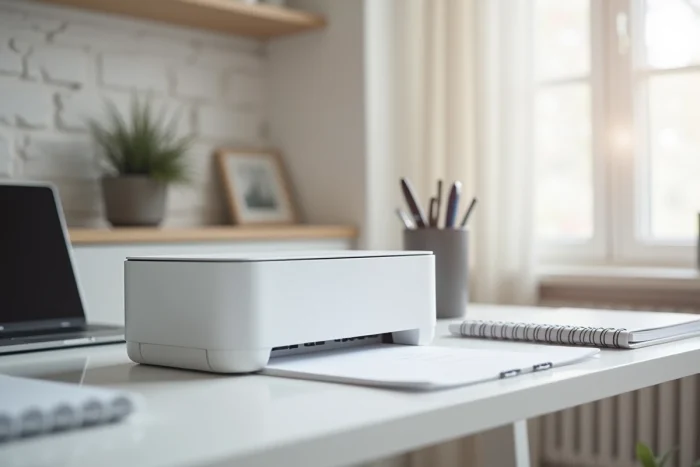
The polygonal mirror of a laser printer takes up space and generates characteristic mechanical noise during printing. Removing this moving part allows LED models to be more compact and quieter.
In a shared office or small space, the mechanical discretion of LED printers makes a real difference. You can place the device in a corner of the desk without disturbing colleagues during document printing.
Fewer moving parts, fewer breakdowns
The rotating mirror is one of the most stressed components of a laser. Its absence in an LED simplifies the design of the optical block. Recent field feedback emphasizes this simplified maintenance more than print quality, which remains comparable between the two technologies in standard office use.
However, if a diode in the LED array fails, the repair may be more complex than a simple mirror replacement. Feedback on this point varies by brand and range.
Print quality laser or LED: a gap often overestimated
It is often stated that laser offers better resolution due to the precision of its single beam. In practice, the difference in output is minimal for office documents: text, tables, presentation graphics. Both technologies use the same toner and the same thermal fusing process.
For demanding color printing (photographs, very precise solids), some high-end lasers retain a slight advantage in detail finesse. For regular black text, the difference is imperceptible.
What really matters in daily use
- Print speed is comparable on recent models of both technologies, with a slight advantage for LED on the first pages due to the absence of mirror rotation
- The cost per page depends more on the model and the price of the toner than on the exposure technology itself
- The quality on ordinary office paper alone does not justify choosing one over the other
Availability of LED models: a limited choice on the market
LED printers remain a niche market. A few manufacturers offer them in professional ranges or specific series, but laser overwhelmingly dominates the consumer market. Hundreds of laser references can be easily found, compared to just a handful of LED models at common retailers.
This asymmetry has practical consequences:
- The choice of compatible consumables (toner, drum) is more limited for LEDs, which can increase long-term operating costs
- Spare parts and technical support are more accessible for laser printers, better documented by manufacturers and online communities
- In case of an urgent need for replacement, finding an equivalent LED model in stock may take time

Electricity consumption and carbon footprint: the recent repositioning of LED
Manufacturers are now placing more emphasis on the reduction of electricity consumption in their LED ranges. The absence of a motor for the polygonal mirror contributes to slightly lower operational consumption.
This marketing repositioning reflects a broader trend. For a fleet of several dozen printers in a company, the cumulative consumption difference over several years can justify the initial higher cost of an LED model.
On an individual workstation, the energy savings remain marginal. The environmental criterion mainly weighs in the purchasing policies of large organizations.
Laser or LED printer: choice criteria based on context
The choice between laser and LED is not just a question of print quality. It depends on volume, available space, consumables budget, and ease of maintenance.
For regular office use with moderate volume, a compact LED model is suitable if noise and footprint are significant constraints. For a fleet of printers where the availability of parts and consumables is paramount, laser remains the safest choice due to its massive presence in the market.
The technical debate between these two technologies is fading year by year. What makes the difference in daily use is the range of available consumables, the actual cost per page on the specific model being considered, and the space that can be allocated to it on the work surface.